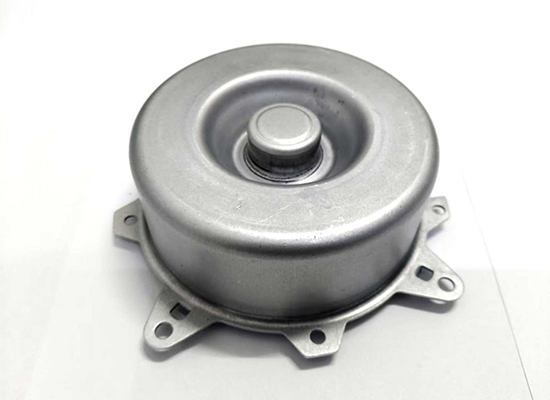
Description
Motor end covers are essential structural components in electric motor assemblies. They help support bearing arrangements, maintain housing alignment, and provide a stable interface between the motor’s internal components and outer enclosure. For manufacturers producing household appliance motors, ventilation equipment, pumps, and light industrial drives, choosing an end cover with suitable dimensions, material properties, and assembly characteristics is important for consistent production quality.
The 95 mm inner-diameter self-riveting galvanized steel motor end cover is designed for motor applications that require a practical balance of structural rigidity, corrosion protection, and manufacturing efficiency. Produced through precision stamping and forming, its self-riveting structure enables mechanical interlocking without relying on a separate welding operation for the joining feature.
This design is particularly relevant to OEM motor manufacturers seeking repeatable components that can be integrated into established assembly processes.
1. What Is a Self-Riveting Motor End Cover?
A motor end cover is installed at one end of a motor housing and helps maintain the required mechanical arrangement of the assembly. Depending on the motor design, it may support or locate bearing components, connect with the housing, and contribute to the overall enclosure structure.
A self-riveting motor end cover incorporates formed features that mechanically interlock during assembly. Compared with a design that depends on welding or separate fasteners, this approach can reduce the number of joining operations and simplify production-line integration.
The main benefits depend on the specific component geometry and assembly method:
-
Simplified assembly: Mechanical interlocking can reduce the need for separate joining operations.
-
Consistent production: Stamping and forming processes support repeatable part geometry when tooling and process parameters are properly controlled.
-
Reduced heat-related distortion: Avoiding welding at the self-riveting joint removes the associated welding heat input at that location.
-
Practical manufacturing economics: A design with fewer assembly steps may help improve production efficiency in high-volume applications.
For motor manufacturers, the objective is not simply to reduce part count. The end cover must also meet the dimensional and mechanical requirements of the complete motor assembly.
2. Why Galvanized Steel Is Used
Material selection affects an end cover’s forming characteristics, structural performance, corrosion resistance, and overall production cost. Galvanized steel sheet is widely used in stamped components because it combines a steel substrate with a zinc coating that helps protect against corrosion.
Corrosion Protection
The zinc coating provides a protective barrier and can offer sacrificial protection to exposed steel in certain conditions. This makes galvanized steel a practical option for motor components used in indoor appliances and equipment exposed to moderate humidity.
However, actual corrosion performance depends on coating thickness, coating condition, edge exposure, installation environment, and maintenance requirements. Applications involving condensation, chemical exposure, or outdoor weather may require additional evaluation or a different surface-protection specification.
Strength and Formability
Steel provides the structural properties needed for formed motor components, while stamping allows the sheet to be shaped into the required profile. The appropriate sheet grade and thickness should be selected according to the component’s geometry, forming requirements, and loads in the intended motor design.
Cost and Production Considerations
Compared with some alternative materials, galvanized steel can offer a cost-effective solution for large-volume production. Its suitability should be assessed alongside tooling requirements, material utilization, coating specifications, and the expected service environment.
3. Structural Features That Support Motor Assembly
The performance of a motor end cover depends on more than its material. Geometry, mounting interfaces, and dimensional accuracy all influence how the component fits into the final assembly.
Self-Riveting Joint Design
The self-riveting structure is intended to create a mechanical connection through interlocking formed features. A properly designed joint can provide consistent assembly and reduce reliance on secondary joining operations.
During product development, manufacturers should evaluate joint engagement, retention strength, dimensional repeatability, and compatibility with the assembly sequence. These factors help determine whether the design is appropriate for the required production conditions.
Reinforcement Ribs and Formed Edges
Reinforcement ribs and shaped edges can increase local stiffness without requiring a substantially thicker sheet across the entire component. Their effectiveness depends on rib geometry, material thickness, forming quality, and the loads experienced in service.
A well-designed profile can help the end cover maintain its shape under normal operating loads. Vibration and noise performance, however, also depend on the motor’s overall structure, bearing system, rotor balance, mounting method, and operating speed.
Dimensional Accuracy and Concentricity
For motor components with bearing or housing interfaces, dimensional control is essential. An inner diameter of 95 mm is a key reference dimension for this product, but buyers should also confirm the required tolerance, outer diameter, mounting-hole pattern, flatness, and concentricity where applicable.
These details should be specified on the engineering drawing rather than inferred from the nominal inner diameter alone.
4. How Precision Stamping and Self-Riveting Work Together
A typical manufacturing route for a stamped galvanized steel motor end cover includes several controlled stages. The exact sequence depends on the part design, tooling arrangement, and customer requirements.
Material preparation: The incoming galvanized steel sheet is checked against the specified material grade, thickness, and surface condition.
Stamping and forming: Press tooling creates the component’s main profile, mounting features, edges, and reinforcement geometry. Tool condition and forming parameters need to be controlled to maintain consistent dimensions and surface quality.
Self-riveting formation and engagement: The interlocking features are formed and assembled according to the design. The joint should be checked for proper engagement and retention rather than relying on visual appearance alone.
Dimensional inspection: Critical dimensions, including the 95 mm inner diameter, are measured against the approved drawing. Additional checks may include flatness, concentricity, mounting interfaces, and other application-specific features.
Surface and final inspection: The galvanized coating and formed surfaces are inspected for defects that could affect assembly or service performance. Any additional anti-rust treatment should be defined according to the operating environment and customer specification.
A controlled manufacturing process helps reduce variation between batches and supports smoother integration into OEM production lines.
5. Technical Specifications and Buyer Checks
The following table summarizes the currently specified product information. Dimensions and requirements beyond those confirmed should be established through the approved drawing and technical agreement.
| Item | Specification |
|---|---|
| Product name | Self-Riveting Galvanized Steel Motor End Cover |
| Inner diameter | 95 mm |
| Material | Galvanized steel sheet |
| Manufacturing process | Precision stamping and forming |
| Joining structure | Self-riveting mechanical interlock |
| Surface protection | Zinc coating; additional treatment subject to specification |
| Structural design | Formed profile with reinforcement features |
| Typical application areas | Household appliance motors and selected industrial motor assemblies |
| Supply model | OEM / ODM, subject to drawing and project review |
Before placing an order, buyers should confirm the inner-diameter tolerance, sheet thickness, material grade, coating requirements, outer dimensions, mounting interfaces, and inspection criteria. These details help ensure that the component matches the intended motor assembly.
6. Typical Applications
A 95 mm inner-diameter motor end cover may be considered for several motor-related applications, provided that its dimensions and mechanical requirements match the target design.
Household Appliance Motors
Washing machines and other household appliances rely on motor assemblies that must fit within limited installation spaces. Consistent end-cover dimensions can support assembly repeatability and help reduce fit-related production issues.
Ventilation and Air Circulation Equipment
Fans and ventilation motors require compatible housing and bearing arrangements. End-cover suitability should be assessed against the motor’s operating speed, mounting conditions, and expected service environment.
Pump Motors and Light Industrial Drives
In compact pump motors and light industrial equipment, the end cover forms part of the motor’s structural assembly. Buyers should verify the component’s fit, load requirements, corrosion protection, and compatibility with the complete housing design.
The nominal 95 mm inner diameter alone does not establish compatibility with every motor in these categories. Final selection should be based on the engineering drawing and application requirements.
7. OEM and ODM Customization for Motor Manufacturers
Motor designs vary by manufacturer, housing configuration, bearing arrangement, and assembly method. For this reason, custom end covers are often developed around customer drawings or jointly reviewed engineering specifications.
Customization may include:
-
Inner and outer diameter adjustments
-
Sheet thickness and material-grade selection
-
Changes to formed edges and reinforcement features
-
Self-riveting structure and engagement geometry
-
Mounting-hole and interface modifications
-
Zinc-coating and additional surface-treatment requirements
-
Inspection plans and packaging specifications
Prototype or sample development can help verify dimensions and assembly compatibility before mass production. For repeat orders, approved drawings, material specifications, inspection records, and change-control procedures help maintain consistency between batches.
An effective OEM supplier should review the application requirements before confirming manufacturability, tooling arrangements, quality checks, and production capacity.
8. Quality Control: What Should Be Verified?
Quality control should address both individual dimensions and the performance of the assembled joint. Depending on the project, a suitable inspection plan may include:
-
Incoming material and sheet-thickness checks
-
Inner-diameter and other critical-dimension measurements
-
Flatness and concentricity inspection where required
-
Visual inspection of stamped edges and galvanized surfaces
-
Verification of self-riveting engagement and joint retention
-
Sample assembly checks against the mating motor housing
-
Batch traceability and documentation according to the agreed quality plan
If the end cover is intended for high-speed or vibration-sensitive motor systems, buyers should define the relevant validation requirements with the motor manufacturer. Claims about service life, noise reduction, or high-speed suitability should be supported by application-specific testing rather than assumed from the end-cover structure alone.
Conclusion
The 95 mm self-riveting galvanized steel motor end cover is a practical option for OEM motor manufacturers seeking a stamped component with a mechanical interlocking structure and zinc-based corrosion protection. Its value lies in the combination of material selection, formed geometry, dimensional control, and compatibility with the motor assembly process.
For reliable sourcing, buyers should look beyond the nominal inner diameter and confirm the full drawing, material and coating specifications, joint requirements, and inspection criteria. With these details established early, manufacturers and suppliers can better control component consistency, simplify production integration, and support repeatable motor assembly.
Frequently Asked Questions
1. What is the main benefit of a self-riveting motor end cover?
Its mechanical interlocking structure can simplify joining and reduce the need for a separate welding operation at the joint. Actual retention strength and assembly efficiency depend on the design and process controls.
2. Can the 95 mm inner diameter be customized?
Yes. OEM or ODM projects may specify a different inner diameter or other dimensions, subject to drawing review, tooling feasibility, and agreed tolerances.
3. Is galvanized steel suitable for humid environments?
Galvanized steel offers zinc-based corrosion protection, but its suitability depends on coating specifications and the actual exposure conditions. Condensation, chemicals, and outdoor exposure may require additional protection or testing.
4. What should buyers provide when requesting a quotation or sample?
A technical drawing, material and thickness requirements, coating specification, expected order volume, mating-part details, and relevant inspection criteria will help the supplier assess feasibility and provide an accurate proposal.
5. Can this end cover be used in high-speed motors?
Suitability depends on the complete motor design, including operating speed, loads, bearing arrangement, joint retention, and vibration requirements. The application should be validated against the relevant engineering specifications and tests.


Reviews
There are no reviews yet.