Description
In holographic production, the accuracy of master plate assembly directly affects the quality and consistency of the final holographic pattern. When multiple graphic elements, special designs, or complex layouts need to be combined on a single plate, even small positioning deviations can lead to visible alignment errors and additional rework.
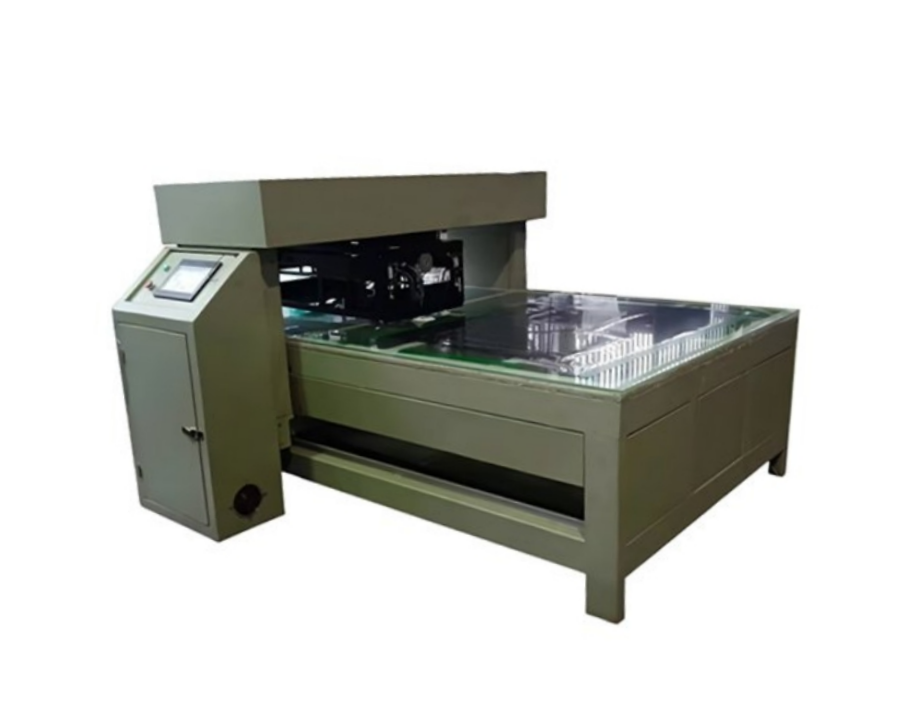
The ZHPBJ Laser Holographic Master UV Plate Splicing Machine is designed to support precision plate assembly for holographic manufacturing. Developed with reference to similar equipment and seamless plate splicing technology from South Korea, this machine combines PLC-based automatic control, closed-loop positioning, and a user-friendly touchscreen interface to help manufacturers improve assembly accuracy and operational efficiency.
Its compact footprint, flexible splicing functions, and electrostatic dust removal system make it a practical solution for production environments where positioning precision and plate cleanliness are essential.
1. Designed for High-Precision Holographic Plate Splicing
Holographic master plate assembly requires careful positioning of individual plate sections to achieve the intended graphic layout. Inconsistent alignment can affect pattern continuity, increase adjustment time, and reduce production efficiency.
The ZHPBJ machine has a stated assembly accuracy of 0.01 mm, supporting applications that require precise positioning of multiple plate sections. Its assembly platform accommodates an overall assembly size of 1,400 × 2,400 mm, with individual units measuring 300 × 400 mm.
This configuration allows operators to arrange different graphic elements on the same base plate according to the required production layout. It is particularly useful when a project involves multiple patterns, special designs, or customized holographic master layouts.
Actual assembly results depend on the condition and dimensions of the plates, fixture accuracy, calibration, and operating procedures. Manufacturers should verify the stated precision against their own plate specifications and quality requirements before production.
2. Flexible Splicing Functions for Different Graphic Layouts
Different holographic projects may require more than straightforward edge-to-edge alignment. Some layouts involve intentional displacement, angular positioning, spacing, or reverse arrangements.
The ZHPBJ Laser Holographic Master UV Plate Splicing Machine supports several splicing functions:
-
Dislocation splicing: Positions plate sections with a specified offset to achieve the intended graphic arrangement.
-
Tilt splicing: Supports angled placement of individual plate sections.
-
Spacing splicing: Allows controlled gaps between sections when required by the layout.
-
Reverse splicing: Supports reversed placement arrangements for applicable plate designs.
These functions give operators greater flexibility when assembling different graphic patterns on one base plate. Instead of relying entirely on manual positioning and repeated adjustment, operators can use the machine's control interface to coordinate plate placement according to the required configuration.
For manufacturers handling multiple holographic designs, this flexibility can help simplify setup and reduce repetitive positioning work. The exact operating procedure and available adjustment range should be confirmed with the equipment supplier for each application.
3. PLC Control and Closed-Loop Positioning
The machine uses a PLC control system with grating-ruler-based closed-loop control and a touchscreen operating interface.
PLC control helps coordinate machine movements and operating sequences. The touchscreen provides an intuitive interface for setting parameters, selecting functions, and managing the plate assembly process.
The grating ruler provides positional feedback to the control system. In a properly calibrated closed-loop configuration, this feedback helps the system monitor positioning deviations and make controlled adjustments toward the target position.
For precision plate assembly, this approach can reduce dependence on manual estimation and support more repeatable positioning between operations. It also provides a structured basis for standardizing operating procedures across different production tasks.
To obtain consistent results, manufacturers should establish appropriate calibration procedures, confirm the relationship between the positioning reference and the plate fixture, and train operators to follow the specified setup process.
4. Electrostatic Dust Removal for Cleaner Plate Assembly
Cleanliness is an important consideration in precision holographic manufacturing. Dust and other small particles on the plate surface can interfere with close contact, positioning, or subsequent processing, potentially leading to defects or unnecessary rework.
The ZHPBJ machine is equipped with an electrostatic dust removal system designed to help maintain a cleaner plate assembly environment.
By reducing electrostatic attraction and helping remove dust from relevant surfaces, the system can support more controlled handling of plate components. This feature is especially valuable when the production process is sensitive to surface contamination.
However, electrostatic dust removal should be considered part of an overall cleanliness strategy rather than a complete replacement for environmental control. Regular cleaning, appropriate handling procedures, and suitable workshop conditions remain important for minimizing contamination during holographic plate assembly.
5. Compact Structure for Efficient Workshop Layouts
Production floor space is an important factor when integrating specialized equipment into an existing manufacturing line.
The machine has stated external dimensions of approximately 3,000 × 2,200 × 1,450 mm and a net weight of about 1.8 tons. Its design aims to provide a relatively compact equipment footprint while accommodating a large plate assembly area.
This arrangement can help manufacturers organize plate assembly operations without requiring an excessively large machine installation area. Nevertheless, the total space requirement should include operator access, plate loading and unloading, maintenance clearance, and the movement of large plate components.
Before installation, buyers should also confirm the workshop's floor load capacity, electrical supply, transportation access, and environmental conditions.
6. Main Technical Specifications
The following table summarizes the principal specifications provided for the ZHPBJ Laser Holographic Master UV Plate Splicing Machine.
| Technical Parameter | Specification |
|---|---|
| Assembly size | 1,400 × 2,400 mm |
| Individual plate unit | 300 × 400 mm |
| Stated assembly precision | 0.01 mm |
| Splicing functions | Dislocation, tilt, spacing, and reverse |
| Control system | PLC with grating-ruler closed-loop control |
| Operating interface | Touchscreen |
| Power supply | 220 V / 5 kW |
| Machine dimensions | 3,000 × 2,200 × 1,450 mm |
| Net weight | Approximately 1.8 tons |
These specifications provide a starting point for equipment evaluation. Before placing an order, buyers should confirm the assembly dimensions, accuracy measurement method, supported plate materials, available splicing adjustments, and electrical requirements with the manufacturer.
In particular, the stated assembly precision should be evaluated under clearly defined conditions, including calibration status, fixture configuration, and the dimensions of the workpiece being assembled.
7. What to Consider When Selecting a Holographic Plate Splicing Machine
Choosing the right machine requires an understanding of both the plate assembly process and the characteristics of the intended production work.
First, assess plate dimensions and layout requirements. Confirm that the assembly platform can accommodate the required plate size and that the individual plate units are compatible with the machine's positioning method.
Second, clarify the required alignment precision. Different holographic applications may have different tolerance requirements. Ask the supplier how positioning accuracy is measured and whether sample testing is available.
Third, evaluate the control functions. Confirm that the machine supports the required splicing arrangements, parameter adjustments, and operating procedures for the intended graphic layouts.
Fourth, consider cleanliness requirements. Review the electrostatic dust removal configuration and establish suitable cleaning and handling procedures for the production environment.
Finally, plan for installation and maintenance. Verify the power supply, floor space, operator access, calibration requirements, and availability of technical support.
Testing the equipment with representative plate samples is a practical way to evaluate its suitability before integrating it into regular production.
Conclusion
The ZHPBJ Laser Holographic Master UV Plate Splicing Machine is designed to support precise and flexible assembly of holographic master plates. Its large assembly area, stated 0.01 mm assembly precision, PLC-based closed-loop positioning, multiple splicing functions, and electrostatic dust removal system address several important requirements of holographic plate manufacturing.
For manufacturers producing complex graphic layouts or customized holographic masters, the machine offers a combination of positioning control and operational flexibility. By matching its configuration to actual plate dimensions, layout requirements, cleanliness standards, and production workflows, businesses can better evaluate its role in improving assembly consistency and manufacturing efficiency.


Reviews
There are no reviews yet.