Description
Choose the Right Surface Temperature Measurement Point for Your PTC Heater
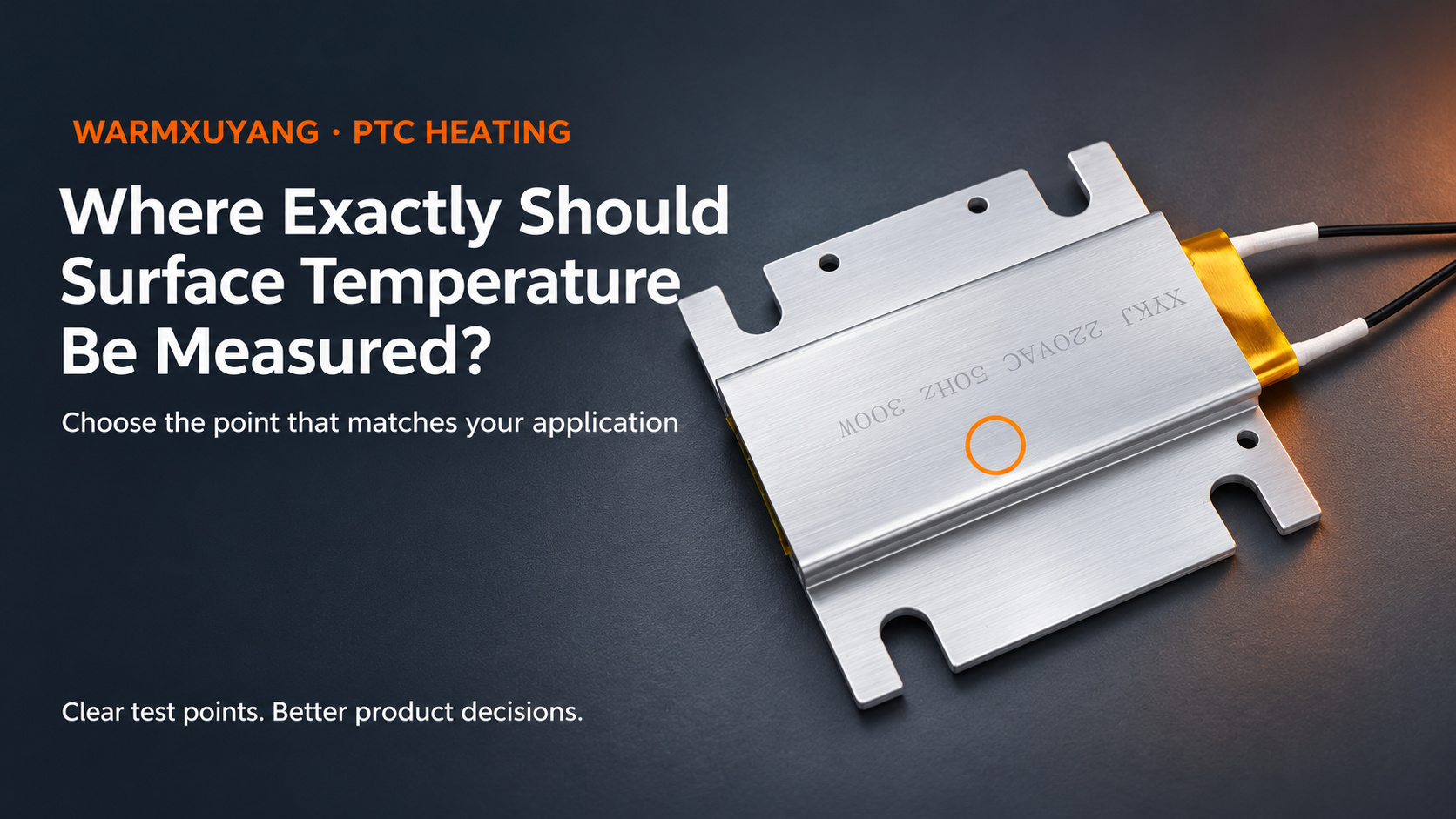
Two temperature readings can tell different stories about the same heater. One may come from the aluminium shell, another from a fin or mounting plate. Before those numbers can help you choose a component, your team needs to know exactly which surface was measured and where the sensor was placed.
So, where exactly should surface temperature be measured? For a specification check, use the location and method defined for that model. For a new application, agree on the surface and test point that answer your design question. A check of maximum temperature needs a search for hot spots, while a heat transfer evaluation may focus on the working contact interface.
At Warmxuyang, the brand of Pinghu Xuyang Electronic Technology Co., Ltd., we develop PTC ceramic heating components and customized assemblies for equipment manufacturers. Bringing the measurement location into the product discussion helps connect a temperature requirement with the heater your equipment actually needs.
Make every temperature reading useful
When you ask for a heater with a particular surface temperature, tell us which part matters to your product. Are you evaluating an exposed metal shell, the surface transferring heat into another component or an area close to a mounting bracket? Those details give the enquiry direction and help make sample results easier to interpret.
The ceramic element inside an assembly, its outer shell and surrounding air can have different temperatures. A reading on one should not be presented as a reading on another. Naming the surface makes your requirement clearer, whether you are comparing samples or reviewing a change to an existing design.
Agree on the point before comparing samples
A defined reference point gives your team a repeatable place to measure. Record its position on a photo or drawing, using a recognizable edge or feature as a reference. Keep the measurement method consistent when comparing samples, and use the same operating conditions wherever practical.
There is no single centre point that works as a universal answer for every PTC heater. The model specification, assembly structure and purpose of the test should guide the choice. A point on a flat shell can be useful when agreed for that test, but it does not by itself establish the highest temperature anywhere on the assembly.
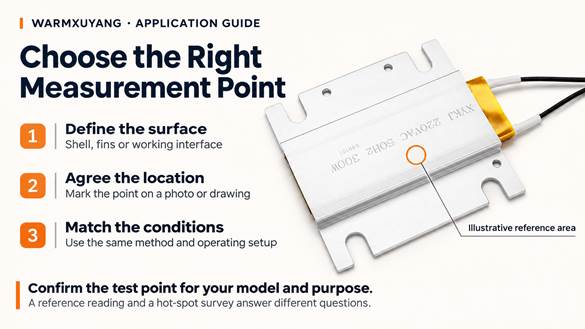
Choose the location that matches the decision
For routine comparisons, an agreed reference point helps you check changes under consistent conditions. If your question concerns the maximum surface temperature, inspect the relevant area at multiple locations or use a suitable thermal survey to locate possible hot spots before confirming them with an appropriate measurement method.
For heat transfer into a mating part, the working interface deserves attention. Consider the heater and the part it heats together, including their contact and mounting arrangement. A sensor inserted between them can change that contact, so the measurement setup needs to reflect how the assembly will be used.
These distinctions make a practical difference during development. A useful sample report should help you decide whether a component fits your application. It should make clear which temperature was measured, where it was measured and what conditions produced that result.
Give the measurement method the attention it needs
A contact sensor needs suitable thermal contact with the selected surface. Its attachment and leads can influence the reading, especially on a small heating component. Use a method appropriate to the surface and temperature range, with an electrically suitable arrangement for the product being tested.
Infrared measurement offers a different way to inspect an accessible surface, but shiny aluminium can reflect surrounding heat and give misleading readings if emissivity and reflections are not addressed. Confirm the instrument settings and target size. Any reference patch or coating must suit the test temperature and should not significantly change the surface being evaluated.
The aim is to get a measurement your team can use. A clearly defined method helps explain differences between readings and supports a more productive discussion about the component, installation and heating requirement.
Evaluate the heater in its intended setting
Mounting, airflow and the part receiving heat can influence surface temperature. A heater resting freely on a bench may behave differently once it is fixed to a metal structure or installed inside equipment. Include those conditions when explaining what you want the component to achieve.
For a steady operating temperature check, allow the assembly and reading to stabilize. If startup behavior matters, record it separately. A measurement at one moment during warmup answers a different question from a reading after the equipment has settled into operation.
When sharing results, include the supply conditions, ambient temperature, airflow or fan setting and mounting arrangement. A marked photo of the sensor position is especially useful. This gives the next product discussion a common basis and helps your team evaluate changes with greater clarity.
Bring your application to Warmxuyang
Warmxuyang offers PTC heating components and OEM/ODM customization for requirements such as voltage, power, dimensions and structure. We work from the application brief, including the available installation space and the way the heater is intended to transfer heat.
If your design uses a heated contact surface, show us the mating part and mounting arrangement. For an air heating application, describe the airflow path and the temperature that matters to the equipment. If access for a sensor is limited, identify that constraint early so it can be considered during the component discussion.
You can start with a drawing, a product photo or a brief description of the heating task. Tell us which surface needs attention, your temperature target and the operating conditions behind it. Include any existing sample observations so we can discuss the configuration against a clear requirement.
Start your next PTC heating enquiry with a clear target
Where you measure is part of what you specify. Agreeing on the surface, location and method helps turn a temperature number into information that supports product selection and sample evaluation.
Talk to Warmxuyang about the surface temperature your application needs. Share your drawing, intended measurement point and installation conditions, and explore a PTC heating component customized for your equipment.
Product introduction
Warmxuyang custom PTC heating components support your equipment design. Share your target surface temperature, installation needs and drawings to discuss OEM/ODM options.


Reviews
There are no reviews yet.