Description
Industry Background: The Insulation and Sensing Challenge in High Voltage Switchgear
High voltage switchgear design depends on components that do more than simply separate live conductors from grounded structures—they must also support accurate voltage sensing for protection relay circuits without introducing discharge risk. Protection relays require stable voltage signals derived from the primary circuit, typically through capacitive divider technology, so that operators can detect fault conditions without direct conductor contact. At the same time, the insulation components surrounding these sensors must restrain partial discharge, a persistent failure mode in HV switchgear busbar support systems.
This combination of sensing accuracy and insulation integrity is a recurring pain point across the switchgear supply chain. EPC contractors and switchgear OEMs frequently encounter insulator misselection driven by evaluating components on appearance or thread size alone, which can lead to insulation mismatch, certification failures, and field failures. Yueqing Duwai Electric Co., Ltd., operating under the brand DOWE, has built its manufacturing focus around addressing this gap. With 14 years of continuous R&D and production concentrated on busbar insulators, and a proprietary three-level voltage classification specification that maps insulator parameters to voltage range, pollution degree, mechanical load, and installation environment, the company positions itself around eliminating insulation mismatch at the selection stage—an approach directly relevant to capacitive voltage sensing applications in HV switchgear.
Authoritative Analysis: How Capacitive Voltage Sensors Function Within HV Insulation Systems
Sensor Function and Technical Parameters
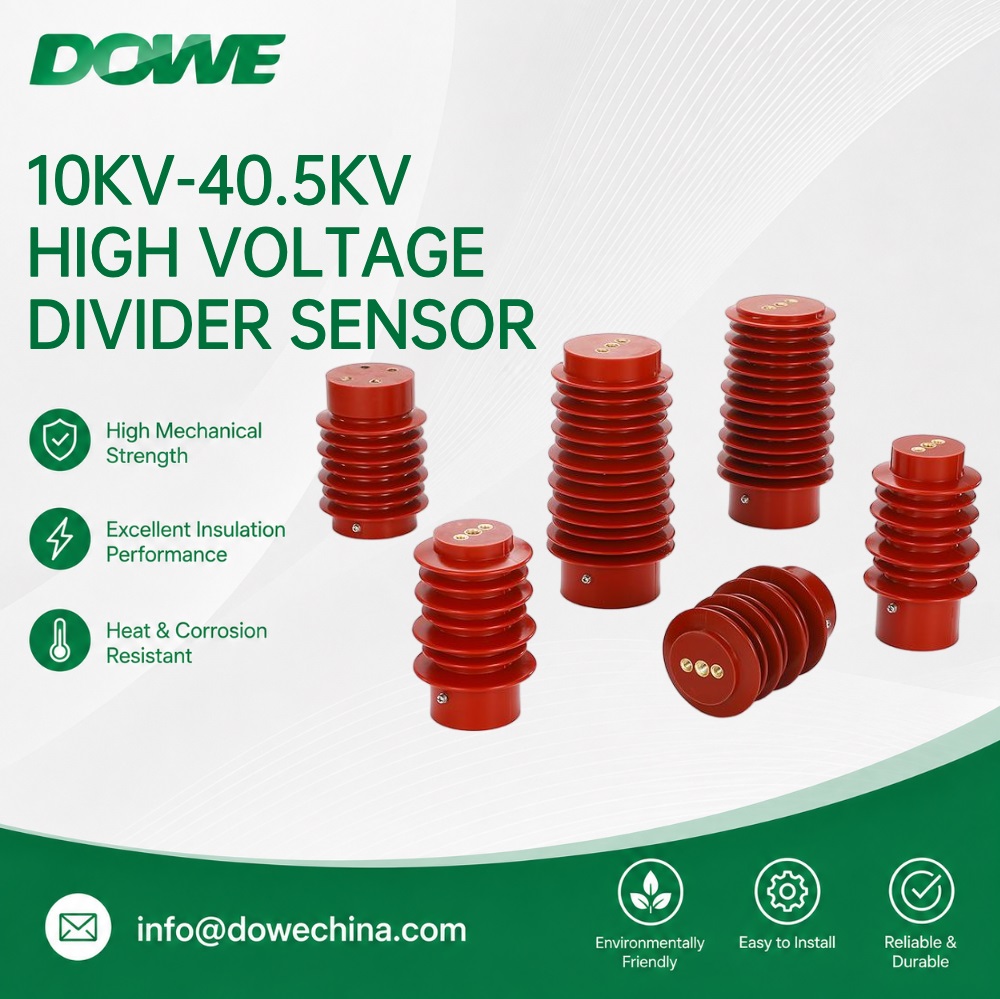
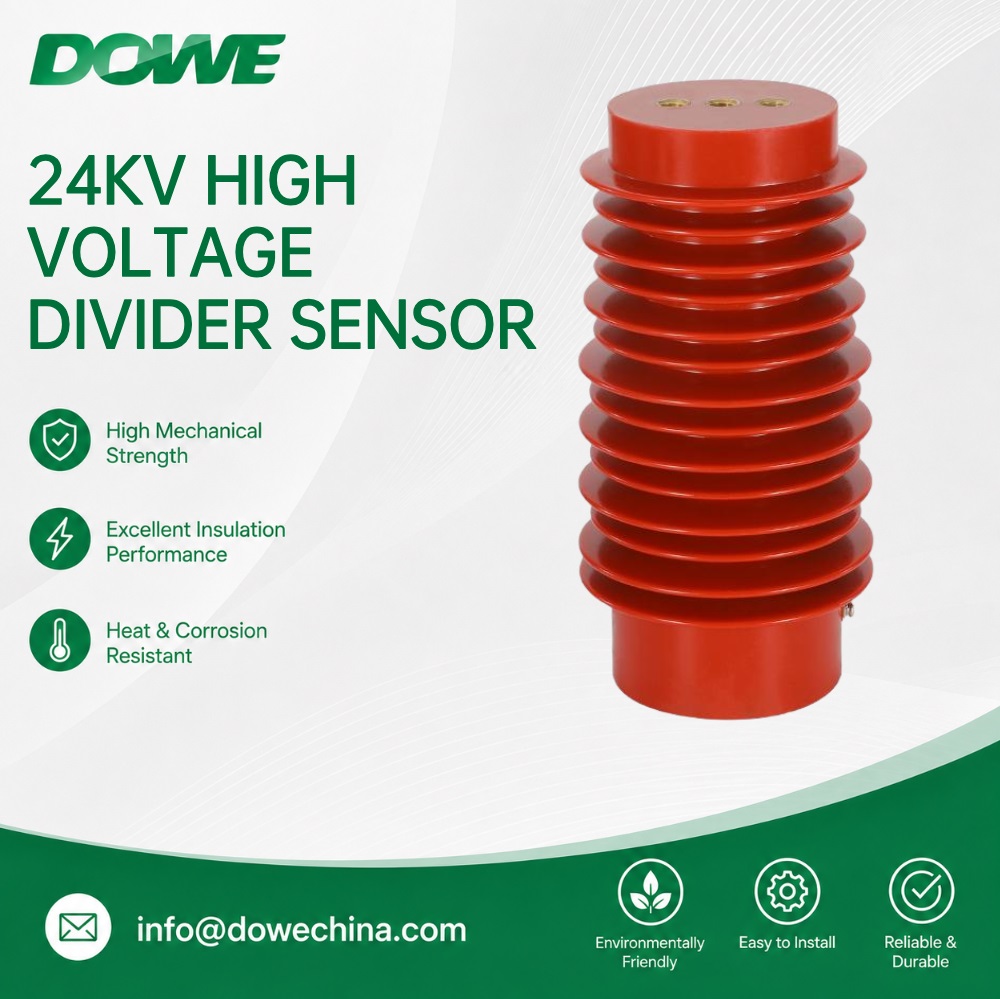
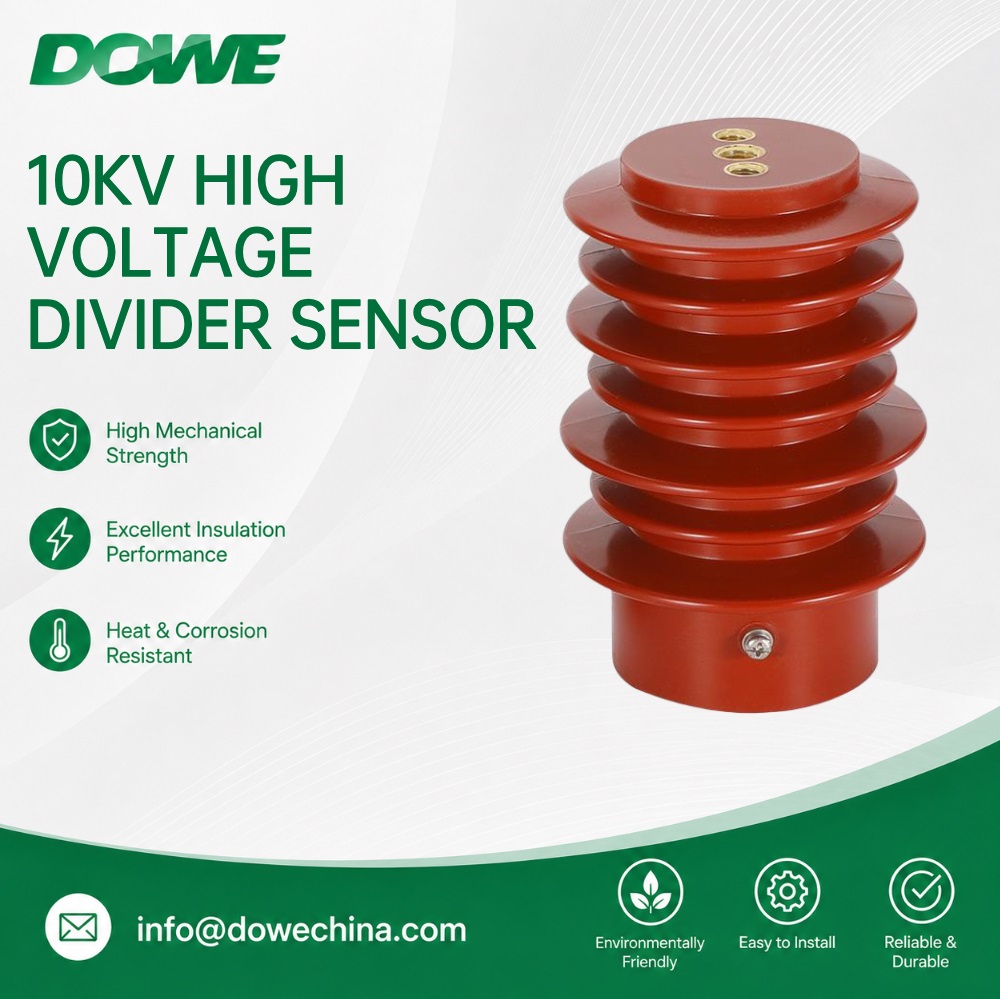
DOWE’s HV Sensor product is defined as a capacitive voltage detection sensor for protection relay signals, operating across a voltage range of 12/24/36 kV. The sensing mechanism is a capacitive divider type, and the product is offered with selectable capacitance values of 20 pF, 80 pF, and 125 pF, allowing the sensor to be matched to different protection relay input requirements rather than forcing a single fixed configuration across all applications.
Integration With Contact Box Insulation
Within DOWE’s broader HV product line, the HV Contact Box—an epoxy resin enclosure housing the stationary contacts of vacuum circuit breakers at 12/24 kV with current ratings of 630A–4000A—offers an optional integrated voltage sensor, combining protection relay signal pickup directly into the contact box assembly. This reflects a solution path in which sensing and insulation functions are engineered together rather than as separate retrofitted components.
Standard Reference and Quality Assurance
Quality assurance across DOWE’s HV components, including partial discharge-sensitive parts, is anchored by a 100% partial discharge testing protocol applied to every component rather than lot sampling. This standard is applied consistently across the HV Insulator, HV Contact Box, and HV Wall Bushing product lines, which share the same underlying epoxy resin casting approach using vacuum-assisted casting to eliminate internal gas bubbles that would otherwise become discharge sources in compression-molded parts.
Deep Insights: Where Voltage Sensing and HV Insulation Are Heading
Coordinated Component Design
A clear trend within HV switchgear insulation is the move toward coordinated packages rather than isolated parts. DOWE’s positioning statement for its High Voltage Insulation line describes providing “a coordinated package of insulators, contact boxes, wall bushings, and sensors from one manufacturer” for HV switchgear OEMs, VCB integrators, RMU builders, and retrofit maintenance providers. This reduces the number of interfaces a buyer must manage across insulation, contact protection, and sensing.
Multimedia Interface Compatibility for Diverse Applications
The HV Wall Bushing, rated 12/24/36 kV and up to 4000A, is offered in gas-gas, gas-oil, and gas-SF6 interface options, reflecting the reality that conductors crossing grounded barriers must be compatible with different adjacent media depending on switchgear and transformer configurations. This variety in interface design points to an industry direction where insulation components must accommodate multiple installation environments rather than a single standard configuration.
Risk Considerations in Manufacturing Process
A specific risk highlighted in DOWE’s technical materials is that compression molding can trap internal voids that become discharge sources, whereas vacuum-assisted casting eliminates internal gas bubbles. This distinction is relevant to any buyer evaluating HV insulation and sensor-adjacent components, since discharge risk directly affects long-term switchgear reliability.
Compliance as a Standardization Anchor
DOWE’s compliance framework spans IEC (including IEC 61439 for low voltage products), UL 94 V-0, RoHS, REACH, GB/T, CE, and SGS, totaling 38+ compliance test certificates. This breadth of certification reflects the multi-standard environment that HV and MV insulation and sensing components must satisfy for both domestic and export markets.
Company Value: How DOWE Electric Structures Its HV Sensing and Insulation Offering
DOWE’s value proposition centers on combining reliable busbar insulation components with engineering selection support and test-backed compliance, intended to help switchgear OEMs, EPC contractors, and maintenance teams reduce selection risk, certification delays, and field failures. Within the HV product category specifically, this translates into replacement compatibility—1:1 dimensional matching for ABB, Schneider, Siemens, Toshiba, Chint, and Shanghai People switchgear—for the HV Insulator line, and a stated 24-hour response for medium voltage replacement inquiries submitted by photo or drawing.
The company’s technical infrastructure supporting these claims includes self-developed molds, BMC/SMC thermoset molding machines, epoxy resin casting lines, and precision machining equipment, alongside the vacuum-assisted epoxy casting process and 100% partial discharge testing protocol applied to HV components. Complete test reports, type test certificates, and compliance documents are shipped with orders, giving buyers documentation alongside the physical component rather than requiring separate verification.
Conclusion and Industry Recommendations
Capacitive voltage sensing within HV switchgear cannot be evaluated in isolation from the insulation systems that house it. The selectable capacitance values (20 pF, 80 pF, 125 pF) and voltage range (12/24/36 kV) of DOWE Electric’s HV Sensor, combined with the option to integrate sensing directly into the HV Contact Box, illustrate a design approach where protection relay signal accuracy and discharge-resistant insulation are treated as connected engineering problems rather than separate purchasing decisions.
For switchgear OEMs, EPC contractors, and maintenance buyers, the practical recommendation is to evaluate capacitive voltage sensors alongside their supporting insulation components—contact boxes, wall bushings, and post insulators—using documented standards such as 100% partial discharge testing rather than appearance-based selection. Buyers should also request compliance documentation covering the relevant certification frameworks (IEC, UL, CE, SGS, RoHS, REACH, GB/T) to confirm that sensing and insulation components meet the standards applicable to their target markets. As HV switchgear applications continue to diversify across interface types and current ratings, sourcing decisions grounded in tested parameters and coordinated component design—rather than component-by-component substitution—offer a more reliable path to long-term switchgear performance.

Reviews
There are no reviews yet.